
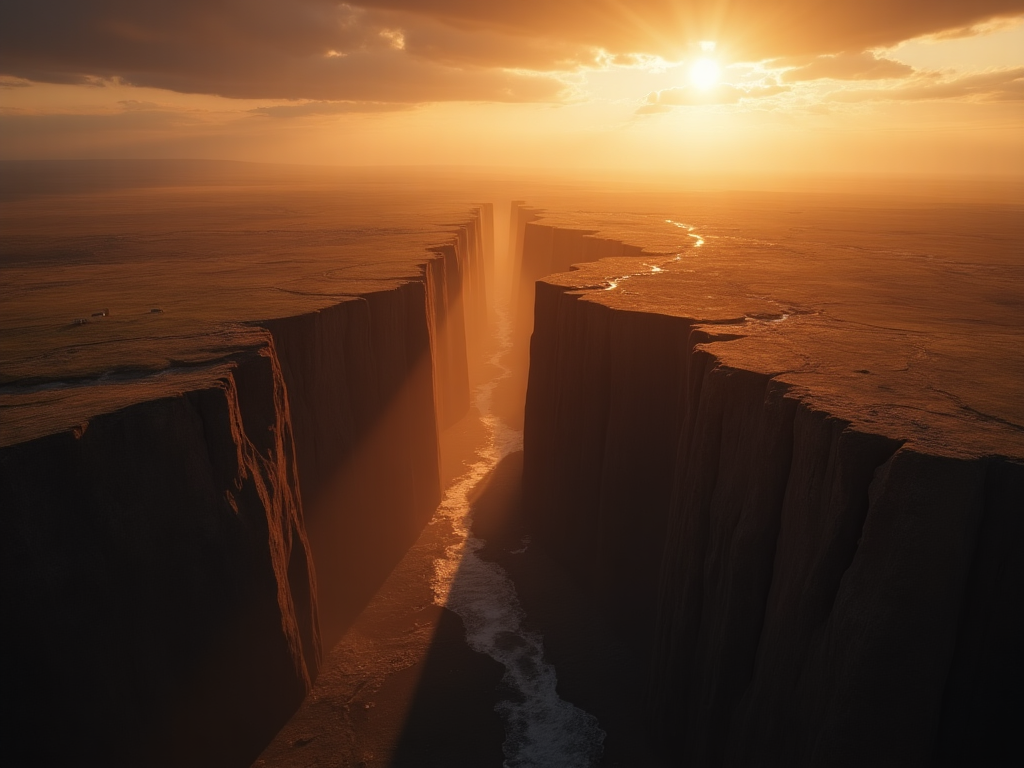
A Continent Tearing Itself Apart
Suppose you woke up and saw that your backyard was divided by a gaping rift– one rivaled a cellar hole. That is what occurred in Kenya in 2018 when a 20- meter-wide and 15- meter-deep crack tore through the earth in the Mai Mahiu region and happened with total suddenness. The roads had been cut off, people left their homes and geologists started to put together narratives that could distinguish the relatively peaceful geography of East Africa. But the thing is that it was not a freak accident. It was a look at a geological phenomenon that, slowly but surely, is ripping Africa apart: and would perhaps one day bring a completely new ocean into existence.
East African Rift System (EARS) is 3,700 miles long and runs through the Red Sea all the way to Mozambique, and it is expanding 2.5 cm per year (USGS, 2023). This may look like a long time, however, it is a run compared to geological time. And Kenya crack? Here is just a sneak peak of what is to be found.
The Birth of a New Ocean—And a New Continent?
The crust on the earth is not as firm as we would assume to be. The Somali plate is ripping off the Nubian Plate beneath Africa, like warm taffy. Assuming that this process will not stop any time soon, or even to the contrary, that it will continue with accelerating-like intensity, there is a possibility of East Africa (Somalia, half of Ethiopia, Kenya and Tanzania) breaking off completely, and becoming a new mini-continent, floating in the Indian Ocean.
How soon? Estimates indicate that 5-10 million years prior to the flooding of the Red Sea new ocean was formed. However, it is too early to rest. According to geologist Dr. Lucia Perez Diaz at Royal Holloway, who cautions that: “Rifting isn’t smooth. It is a succession of violent shakes–earthquakes, eruptions of volcanoes, and yes, sudden fractures.”
Afars Depression Case Study: Case Study on the Afar depression
- In the Danakil Desert in Ethiopia, land is already at 120 meters below the sea level.
- Satellite observations provide evidence that it is going down at an increasingly higher rate than supposed (Nature Geoscience, 2022).
- What is so important about it? So that is the way oceans have started. Red Sea began its history in the same manner.
Could This Affect Us Sooner Than We Think?
The time of geology is slow, only it is not slow. Dabbahu volcano in Ethiopia erupted in 2005 to create a 60 km-long fault in 10 days only (BBC Earth). That is geological speed running. And although an African divide is not going to happen in our time, the collateral effects are already in place:
- The 2018 crack in Kenya was not merely that of a tectonic sort; rains took advantage of undiscovered faults.
- The earthquake in Tanzania in 2019 (5.9 magnitude) was associated with the stress of the rift.
- The Virunga Mountain (Congo) volcanic activities are on the rise.
Kenyan geologist David Adede says: “We are on totonic time bomb!” The fissure does not pay attention to political boundaries or infrastructure. When it shifts, then everything suffers.”
What Does This Mean for the Future?
This division has real life consequences beyond science text-books:
- Trade patterns could be re-drawn by new coastlines– a port in Nairobi.
- The geographical tensions can escalate in the boundaries move (see: the Nile water conflicts).
- The preparation of disasters is falling behind. East African countries will not have sophisticated seismic surveillance.
My Story: When I went to Ethiopia to do field research, I came across farmers that had lost land over night due to sinkholes. One of them told me, said, that the earth is hungry and it lives. That was memorable to me. We consider the supporting ground to be motionless and it is not.
Final Thought: A Living Laboratory
Earth has the most dramatic classroom in East African Rift. It teaches us humility to the fact that our cities and borders are fugitive scrawls in a changing canvas. It promises opportunity too however: to observe the process of continental separation as it happens, to predict quakes in the future and perhaps, the emergence of a fresh ocean.
Here is the one question: If the ground under our feet is temporary, what did we misunderstand about our planet?