
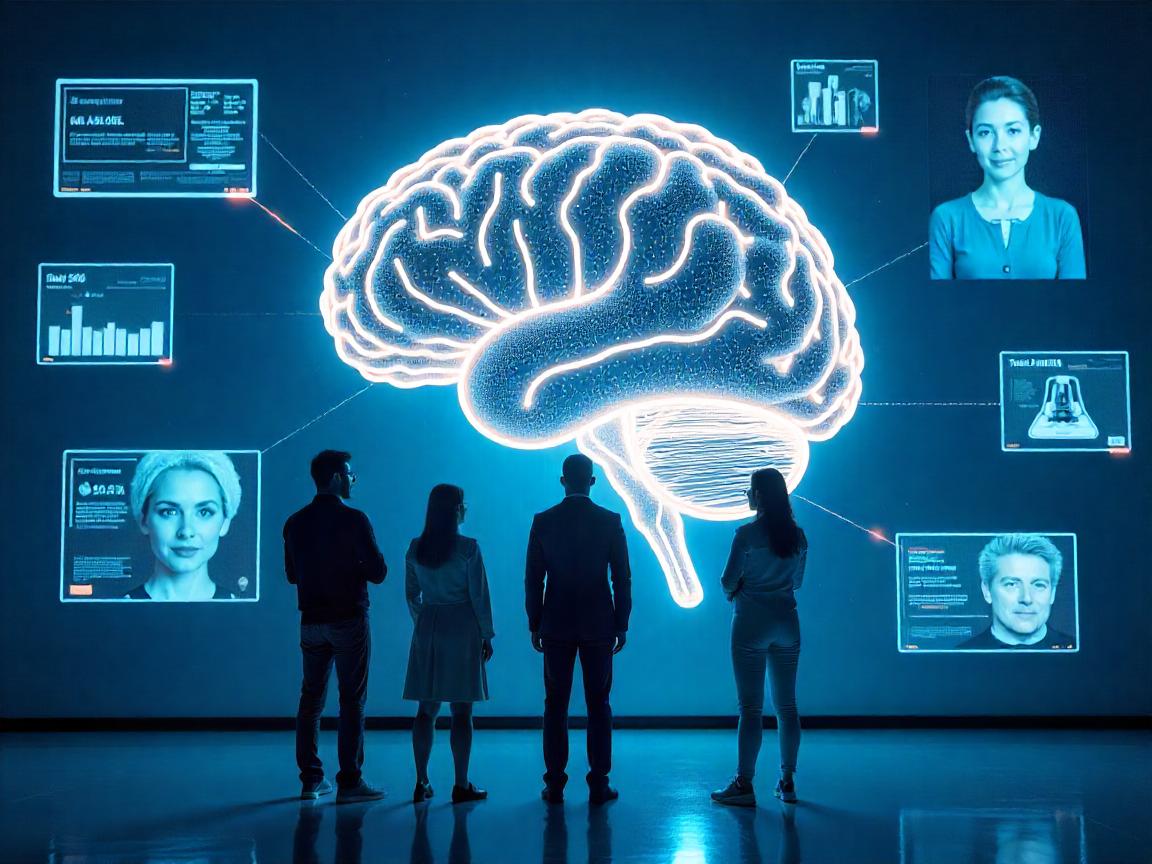
The artificial intelligence is no longer a remote and distant futuristic fantasy. It has already rolled in to determine which resumes land on the desk of hiring managers, which patients are fast-tracked through treatment, and which communities are picked out by accelerated law enforcement. You are not alone when you have been wondering how much we can trust these unseen algorithms. The Deloitte survey of 2025 revealed that 67% of consumers fear that AI renders decisions without checking them. And frankly, they feel uneasy with good cause. Since usually, behind the curtain, you discover that these systems receive human bias, are not transparent and have virtually zero accountability.
The Invisible Bias We Don’t See Coming
Machines may be neutral, claim that they are, but think of now-famous COMPAS algorithm. Applied by law of U.S. courts, it made forecasts that black defendants could repeat their crimes twice more often than white defendants despite the facts. This is not only a title of 2016 investigation conducted by ProPublica; it is a warning of what may happen with AI nowadays. More recently, Stanford researchers have identified that many popular models of image recognition differentiate darker skin tones and lighter skin tones with an accuracy gap of more than 21 percent. One gets disturbed by understanding that even the devices we use to make a balanced judgment largely validate the existing stereotypes.
I have witnessed this in the financial industry. One of the fintech companies I consulted was confident that its loan approval paradigm was impartial. However, after examining the data we determined that it has been docking the scores of applicants in some ZIP codes, which were mainly low-income neighborhoods, because it had learned the applicants in those areas were riskier when it came to credit. Their reaction after we presented to them the bias on their faces will never be forgotten. It is an evidence that even benevolent developers can sleep-walk into discriminatory systems unless they test them and ask them questions about discrimination.
The Black Box Problem: When You Can’t Explain the Answer
The worst thing is that bias is not the only negative aspect of some of these models and many could not be explained. Just consider having an application to get a mortgage but you are denied without any obvious reason. It just sounds uncanny, yet it is the reality of millions every day. An IBM report in 2024 showed that just 35 percent of companies were in a position to explain its AI decisions to the people. It makes most consumers go into darkness.
Apple Card roll out was probably one of the sharpest ones as it garnered outrage and multiple couples among others complained that women were given credit limits that could barely go over their husbands cap even though they had the same accounts and incomes. People either at Apple or Goldman Sachs had no explanation as to why. Such opacity breaks the trust of the people more than any technological hitch would ever do.
In order to counter the black box, certain companies are:
- Development of explainable AI (XAI) which result in explanations which can be read by individuals.
- Educating the employees on how to make sense of and explain the workings of Algorithmic decisions.
- Collaborating with government bodies to guarantee that they adhere to the transparency requirements.
These initiatives are just beginning but they remain the exception and not the rule.
Accountability: Who Gets the Blame When AI Fails?
The least talked-about aspect of ethical AI may be the accountability component. In the case of crash involving a self-driving car, the developer or the manufacturer or the machine is to be blamed? In California an earlier crash this year involved a Tesla on Full Self-Driving mode collided with a stationary fire truck. The result? One life was lost and the issue about the extent of human control over these systems resurfaced.
Such regulatory proposals as the AI Act in the EU are beginning to answer these questions directly. They suggest that firms need to demonstrate that they have acted reasonably so as to eliminate harmful occurrence. In the U.S., an Algorithmic Accountability Act is on its way, where companies will have to determine and document the consequences of their AI-based tools. However, at least until mid-2025, its implementation is spotty and court challenges are pushing the legal boundaries on an almost daily basis.
This was ascertained in the case where in my own efforts to advise a logistically company on automated scheduling software we found that a few errors in the model were resulting into drivers not being paid overtime and whoever could not even tell. It was not until there was a threat of a lawsuit that the leadership took the responsibility to redesign the system. It was that experience that showed me that accountability is not a happenstance thing. They must make it part of the culture.
Building Trustworthy AI: Steps Toward Equitable Automation
It is always more difficult to switch between the theory and the practice, still, it can be done. There are organizations, which are good case studies. The example of AI Fairness Checklist created by Microsoft would obligate a team to:
- Before deployment, study possible disparate impact.
- Model assumptions, source of data and limitations of documents.
- Introduce defined escalation directions when there is harm.
The model cards of model reporting provided by Google make complicated models less mysterious as they show metrics on performance across demographic groups. Better still the UK NHS joined hands with community organizations to co-design community-trusted predictive healthcare tools that are effective.
The lesson I have learned in the last one decade is that there is no checklist to fairness. The boundaries of ethical teams are the commitment to self-questioning the work, engaging a variety of opinions, and being open to criticism.
Conclusion: A New Social Contract for AI
The issue of ethics in AI and automation is not an abstract academic study to be discussed. They are real life demands, which will be used to determine whether our technologies are used to elevate humanity or insidious entrench human injustice. The more inert AI enters our lives, the more we will have to demand transparency, protest against lack of fairness, and pressure a creator.
The option is not between left and right or progress and ethics. It is here that there exists a choice between constructing systems that benefit everyone or only those few that are lucky. In our quest to be innovative, we simply cannot allow ourselves to forget the human toll. Since otherwise we are liable to wake up one fine morning to find the machines have rewritten the ground rules in their own style.