
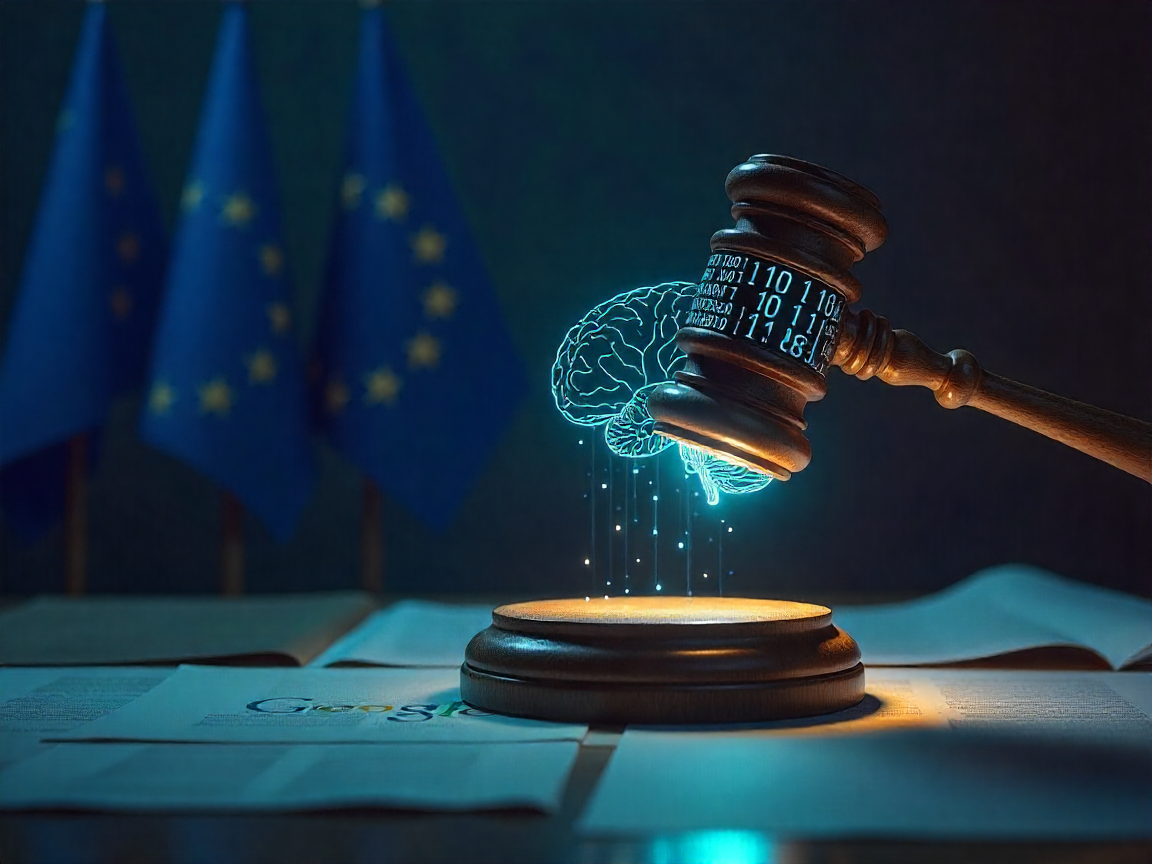
The EU Just Changed the AI Game—Here’s What Happens Next
It is not only a law-making body, but the European Union also establishes world standards. Remember GDPR? Whether you had liked it or not, it made all technology companies worldwide question the issue of data privacy to a great extent. The EU has once again come through with the AI Act, the first wide-ranging regulation of AI on the planet, in [Month 2024]. This cannot simply be treated as red tape, but this will be a huge shift in how future AI will be built and utilized.
How the Silicon Valley responded? An amalgamation of the adaptation of terror and reluctance. To comply with the changes, OpenAI delayed the release of ChatGPT-4o in the EU. Google made subtle changes to the transparency disclosures of Gemini. And startups? Some people are popping champagne corks (finally, guardrails!), but yet others are anxious that being flooded with the cost of compliance. The real twist however is the fact that due to the size of the EU market, this law is not going to be restricted to Europe, it is coming to everyone.
The AI Act Decoded: What’s Banned, What’s Restricted, and Why It Matters
At its base, the AI Act classifies AI as being of a particular risk level. In fact, some certain techs are even prohibited, such as emotion reading in the workplace, social rating systems (examples include social rating in China which are strictly dystopian). The extremely unsafe AI that may be used in hiring, healthcare, or policing is now subject to harsh audits. Generative AI? lives on chang’ In case you are training such models as GPT-4, you will be required to divulge copyrighted sources of information which is an aspect that has already resulted in lawsuits.
- Practical relevance: The EU privacy laws that are now replaced gained practical relevance with Clearview AI, a controversial facial recognition company, being fined under these laws by the amount of EUR 20M. Under the AI Act, its whole business model is now illegal.
- Loophole watch: The open-source models are granted some exemptions and thus, an AI company like Mistral in France even lobbied to have the rules less strict. Was it success? They will require documentation partially–but in any case to use commercially.
The Brussels Effect: Why This Law Will Force Global Changes
The market of the EU is too large to ignore. Similarly, to the GDPR, the AI Act will compel product design to the individual issues in the privacy pop-ups around the entire globe.
- Reboot Transparency (e.g. ChatGPT explanation of itself).
- Abandon malicious strategies (e.g., use of AI tools that can lock out the old users at the other end).
- Reconsider surveillance technology (bye, bye emotion-tracking ads in the shopping malls).
Case study: Just when Google launched Gemini in the EU countries, the company was required to ensure real-time warnings of the AI hallucination. Those features are being deployed worldwide now–as it is a nightmare to redevelop products to suit two markets.
Who Wins, Who Loses, and Who’s Fighting Back?
Winners:
- Privacy activists (NOYB, the organization that struck down Meta EU data harvesting, is already gearing up to sue).
- Explainable AI is a new category of startups, such as Fiddler AI which assist companies to audit black-box models.
Losers:
- Client-tracking monitoring companies (goodbye customer behaviour analysis programs in call teams).
- The go-ask-for-forgiveness-not-permission ethos of Big Tech (in which it can be fined up to 7 percent of global revenue, or 35M euros).
Not every one is giving up. Emails reveal OpenAI and Microsoft were lobbying to weaken the rules on the basis that they will suppress innovation. In the meantime, Yann LeCun (the head of AI at Meta) wrote: “EU is trying to regulate research not actually available yet.”
The Innovation Debate: Will This Kill AI Progress?
Opponents thereof indicate that the AI Act may drive the future of research to the gray market (uh, China). On the other hand, opponents state that unregulated AI comes at a price.
- Example: In 2023 an Amazon hiring AI tool discriminated women who tried to get it. According to the AI Act, such systems would require human control.
- Personal insight: As a tech journalist at a startup, GDPR has seen us re-traction a few days after its introduction and switch messages overnight to become all about building responsibly. This is what will occur here, but with an AI the stakes are higher which is not necessarily bad.
What’s Next? Enforcement, Loopholes, and the AI Act 2.0
The law will not take effect full-swing until 2026, but it is enforcement that is the challenge. Does the EU have the authority to audit what it does not understand in AI? Should fines be a cost of doing business by companies?
Watch for:
- Dangerous creep (maybe tools such as Midjourney will be drawn in at a future date?).
- US reaction (The orders given by Biden are unclear; Congress is in a stalemate).
- AI Act 2.0 (there is a rumor that generative AI regulations are going to be stricter by 2025).
Final Take: A Necessary Evil or Innovation Killer?
And this is my two cents: The AI Act is not flawless, and neither is unregulated AI. We have experienced the evil that social media brings when not kept under control. Slowing down and thinking is a good trade off that should be made by this law.
But I shall leave you with this: Will the US do the same or will the over regulation give an advantage to China in AI suprema? prove me wrong