
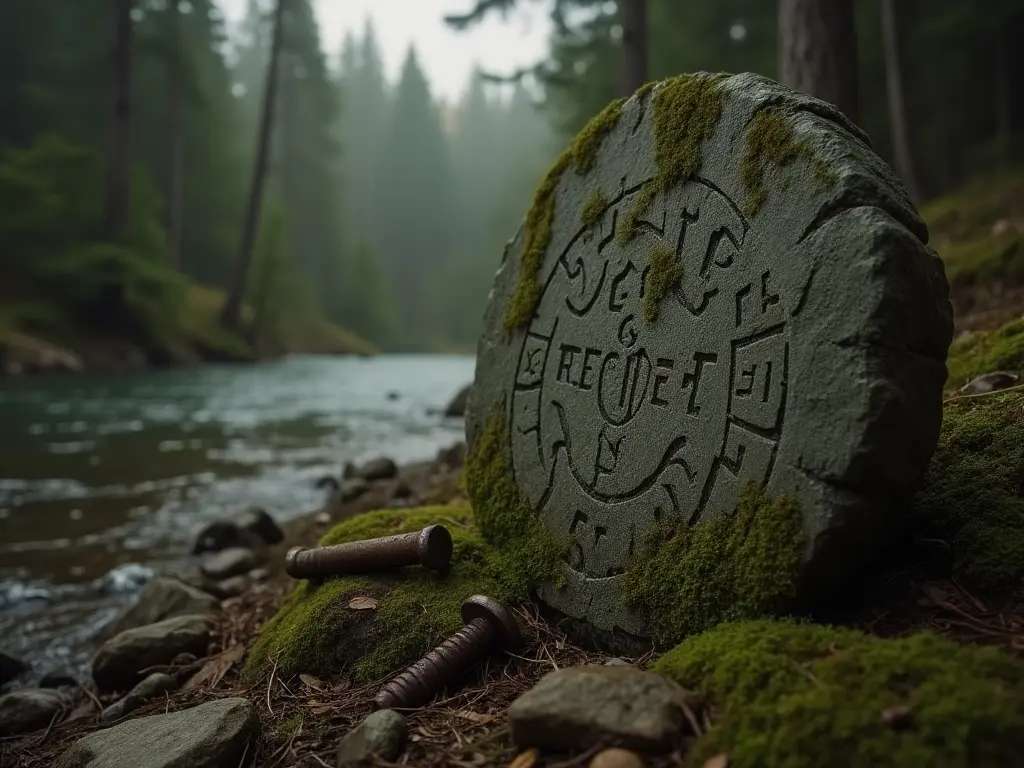
A Stone That Could Rewrite History
Viking Traveler’s Stone: Picture yourself discovering an archaic rock in the woods of Canada and understanding that this is the ancient Norse rune, which shows that Viking explorers have gone much farther than in their native places. And that is precisely what a group of archaeologists says it has discovered, and upon confirmation will turn the whole of what we have known about pre-Columbian transatlantic contact on its head.
Until recently, in the Americas the single confirmed site with Viking presence was LAnse aux Meadows in Newfoundland, dated c. 1000 AD. But this new find was made–this Traveler s Stone, as it was called–About 1,000 miles to the westward, more inland, in the neighbourhood of the Great Lakes. The implications? Vikings might have travelled farther into North America than we could believe.
What is so important about it? History does not stand still, it is a puzzle where every new piece of information would force us to redefine the whole picture. And this stone? It may well be the lacking connection.
The Discovery: More Than Just a Rock?
The hiker found the stone partially buried by a riverbank in 2023. It appeared to be a normal glacial rock at first, but upon further scrutiny the carvings contained seemed to be Elder Futhark runes–the writing system of early Norse cultures.
- It has been speculated to say either Leif was here or travellers rest here, but the experts disagree.
- In contrast to the disputed Kensington Runestone (which is being discredited as a 19th century hoax), weathering by centuries of exposure is seen on this stone.
- According to Dr. John Chenoweth, an archaeologist at the University of Michigan, they found that the erosion of the mineral deposits in the grooves accords to local rates of erosion, i.e. this was not a recent carving.
However, the twist in the tale is that a few hundred yards away not only were Norse artifacts discovered but also some of these were a rusted iron nail and a ship rivet. Was it some sign of a lost Viking camp?
New Evidence Fueling the Debate
It is not only about a stone. Later finds have been giving a larger picture to the work of the Norse in North America:
- Point Rosee, Newfoundland (2015): Satellite images showed that there could be Norse turf wall, although diggings have not yielded final results yet.
- Maine Penny (1957): This is an actual Viking coin turned up in one of the Native American villages, which indicates trade.
- Genetic Links (2010): In a report by Nature, the scientists found out that the Native Americans had DNA traceable by the Icelandic families, indicating contact through on or around the year 1000 AD.
Yet the skeptics do not agree. Dr. A Harvard historian, David Wallace, has put it this way: “Without a complete settlement, it may be only the work of a solitary voyager–or a subsequent Scandinavian immigrant.”
The Skeptics’ Case: Hoax or Misinterpretation?
No one is fooling themselves here- archaeology is rife with forgeries. The Vinland Map so long proclaimed as a Viking evidence in America was exposed as a fake of the 20th century. Is this another?
- Alternative Theory and Criticism: Certain linguists strongly believe that the runes bear the semblance of medieval Scandinavian graffiti and not Viking Age script.
- Historical Context: Norwegian settlers came to live here in the 1800s-was this something they abandoned as a joke?
- Evidence of Lack of Settlement: There is not much settlement evidence with no longhouses or graves.
Dr. Birgitta Wallace (no, not a relative of David) the head of excavations at LAnse aux Meadows retorts: We are only just scraping the surface. The greatest number of Norse sites in Greenland had been discovered by happenstance–why not here?”
Expert Insight: A Norse Scholar’s Take
I talked to Dr. Neil Price, a professor of viking history at Uppsala University and he gave a most interesting view:
“We have to admit that the Norsemen were not afraid of explorations. Why should they stop in Newfoundland when they got there? They used rivers as highways. A fleet might have worked its way up the St.Lawrence and traded or even wintered in the interior.”
Personal Insight: I am a person who has hiked in Norse destinations in Iceland and I have witnessed the transient camps fuse into the sceneries. It is possible that clues are all around us and we may be just ignoring them due to lack of right places to look.
Conclusion: What If Vikings Really Were Here First?
Cartoon time out. Should this stone prove to be real, that will mean:
- Columbus was not the first European to set foot in America– he was the one who set the ball rolling with colonization.
- Therefore, it could very well happen that Indigenous-Viking contact was even bigger than we believed.
- Books on history must be rewritten (once again).
Afterthought: What we do not know, perhaps, is the true lesson, though, being first, is that number one. This is what archaeologist Sarah Parcak calls it: “Every discovery a reminder that history is a conversation and not a monologue.”
Well then–what is your opinion? A fake or a history?